

Mactac B•free® JT5796MBF v2 Frosted – 3.1 Mil Translucent Matte Frosted Window Film – Bubble-Free Dry-Apply Air-Egress Adhesive, 54" × 5–7 Year Durability
Micro-Structured Air-Egress Adhesive | No Application Fluid | Etched-Glass Look | Print It or Use It Blank for Privacy
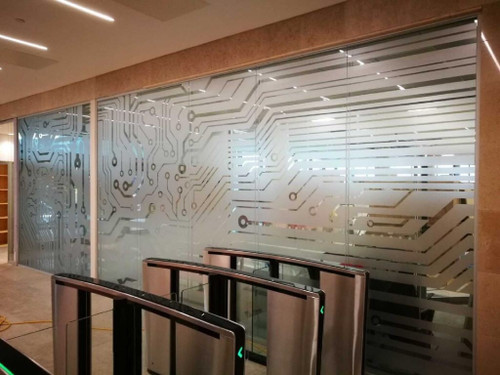
Mactac B•free® JT5796MBF v2 Frosted gives glass the look of etched, sandblasted, or acid-frosted glass at a fraction of the cost — and installs without the mess. It's a 3.1-mil translucent matte frosted polymeric PVC film with a micro-structured, permanent, clear acrylic air-egress adhesive engineered for dry application: air escapes through channels in the adhesive as you squeegee, so the film goes down bubble-free and wrinkle-free with no wet-application fluid and no messy cleanup. Mactac's B•free line is positioned as the market's first dry-apply large-scale window graphic, and the pitch is simple — it cuts application time roughly in half.
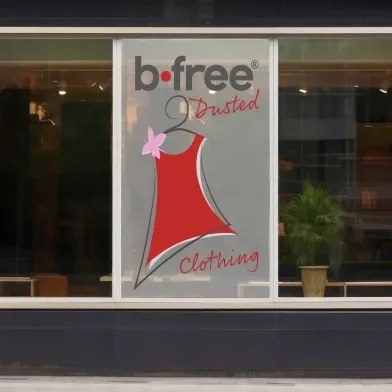
Print it on solvent, eco-solvent, latex, or UV for frosted window graphics, or install it blank as non-printed privacy and decorative window shading. It works for indoor and outdoor window graphics and for internally illuminated light box faces.
Applications
- Privacy glass — conference rooms, offices, medical and dental partitions, entry sidelights
- Decorative frosted graphics — logos, patterns, and manifestation banding on glass doors and walls
- Storefront and retail window graphics with an etched-glass aesthetic
- Non-printed window shading — the film blank, purely for privacy or light diffusion
- Internally illuminated signs and light boxes
- Safety-glass manifestation — visibility marking on full-height glass (verify local code requirements)
The air-egress adhesive has channels that let air escape. Use application fluid and the liquid gets trapped in those channels, which is exactly the failure the technology is meant to prevent. Do not wet-apply this film. If the job calls for a wet application, Mactac recommends JT5798 or the Glass Décor 700 series instead — ask us and we'll point you the right way.
Physical Properties
| Property | Typical Value |
|---|---|
| Film Type | Translucent matte frosted polymeric PVC |
| Thickness (face only) | 2.95 mil (75 µ) |
| Thickness (film plus adhesive) | 4.14 mil (105 µ) |
| Adhesive | Micro-structured, repositionable, permanent, clear acrylic — air egress |
| Peel Adhesion | 3.1–3.7 lb/in (12–18 N/25mm), 180° on stainless steel, 24 hr (FTM-1) |
| Quick Tack | 4.4–5.6 lb/in² (20–26 N/25mm) on stainless steel (FTM-9) |
| Release Liner | 80# polycoated, layflat |
| Dimensional Stability | Max 0.2% at 48 hr / 158°F (FTM-14) |
| Minimum Application Temperature | 50°F (+10°C) |
| End Use Temperature Range | -40°F to 194°F (-40°C to 90°C) |
| Surface Burning | Meets ANSI, NFPA, and IFC Class A — flame spread 5, smoke density 15, per ASTM E84-01 / ANSI-NFPA 255 / IFC 8-1 |
| Outdoor Durability | 5 to 7 years unprinted |
| Shelf Life | 2 years from date of manufacture at 60–77°F and 50% RH in original package |
| Maximum Ink Saturation | 270% |
| Width | 54" |
| Recommended Overlaminate | ColorGard® LUV (where added protection is needed) |
Values are typical and are not necessarily for use in specification. Mactac's window product guide lists durability as 5 years; the JT5796MBF v2 datasheet lists 5–7 years. Confirm with us for a specific job.
Easy Removal
Although designed as a permanent glass application, the film removes easily with little to no adhesive residue. Lift a corner and peel slowly but firmly at a 90° angle. On larger graphics, score the film into 5"–6" wide strips the height of the window and peel one strip at a time.
The B•free® Window Family
| JT5796MBF v2 Frosted | JT5798MBF v2 Dusted | JT5999MBF v2 Clear | |
|---|---|---|---|
| Finish | Matte frosted translucent | Matte dusted translucent | Gloss clear |
| Look | Etched / sandblasted glass | Lighter dusted / softer etch | Transparent — reverse-print to read through glass |
| Thickness | 3.1 mil | 3.1 mil | 3.1 mil |
| Adhesive | Air-egress permanent clear acrylic — dry application | ||
| Width / Durability | 54" / 5–7 yr | 54" / 5 yr | 54" / 5 yr |
Do not mix JT5796MBF v2 with the original JT5796MBF in the same job — the finishes are not an exact match.
Printing Notes
Ink Saturation & Drying
Print in a conditioned pressroom at approximately 73°F and 50% RH; maximum ink saturation is 270%. Solvent, eco-solvent, and mild-solvent prints need 24–48 hours of open-air drying — ink does not dry in a rolled-up print, and it must be fully dry before lamination.
Transport
Roll finished graphics image out at a minimum 6" core diameter. Unlaminated prints must be completely dry and bagged. Avoid extreme temperature and humidity swings in transit and storage.
Installation — Dry, With a Soft Squeegee
Cleaning the Finished Film
Use a soft, lint-free cloth and off-the-shelf glass cleaner (Windex, Glass Plus). Spray the cleaner onto the cloth, not the graphic, wipe with a damp (not saturated) cloth, and dry immediately. If the edges aren't sealed, keep cleaner away from them — over time it causes edge lifting.